










.png)
.png)
.png)
.png)
.png)
.png)
.png)
.png)
What Is AI Contract Management?
AI contract management refers to the incorporation of AI systems into contract management processes to automate and hasten repetitive (e.g., data entry) and time-consuming tasks (e.g., contract drafting and document search), as well as to organise and analyse contract information to generate reports or surface trends that would otherwise be missed or difficult to identify through traditional contract management processes.
The AI technologies typically involved include machine learning (ML), natural language processing (NLP), agentic AI, generative AI, and optical character recognition (OCR).
How Does AI Improve Contract Management?
The primary purpose of AI in contract management is not simply to automate work, but to help teams manage contracts more efficiently while minimising human error and making better-informed decisions. By handling repetitive and administrative tasks different stages of the contract lifecycle and providing insights, AI helps legal and business teams focus on work that requires greater expertise, judgment, and strategic thinking. Here are some aspects of contract management where AI helps:
1. Data Extraction
AI can extract relevant information from existing contracts and documents using NLP and OCR to automatically populate approved templates and clause libraries, reducing the manual work involved in preparing contracts.
2. Contract Review
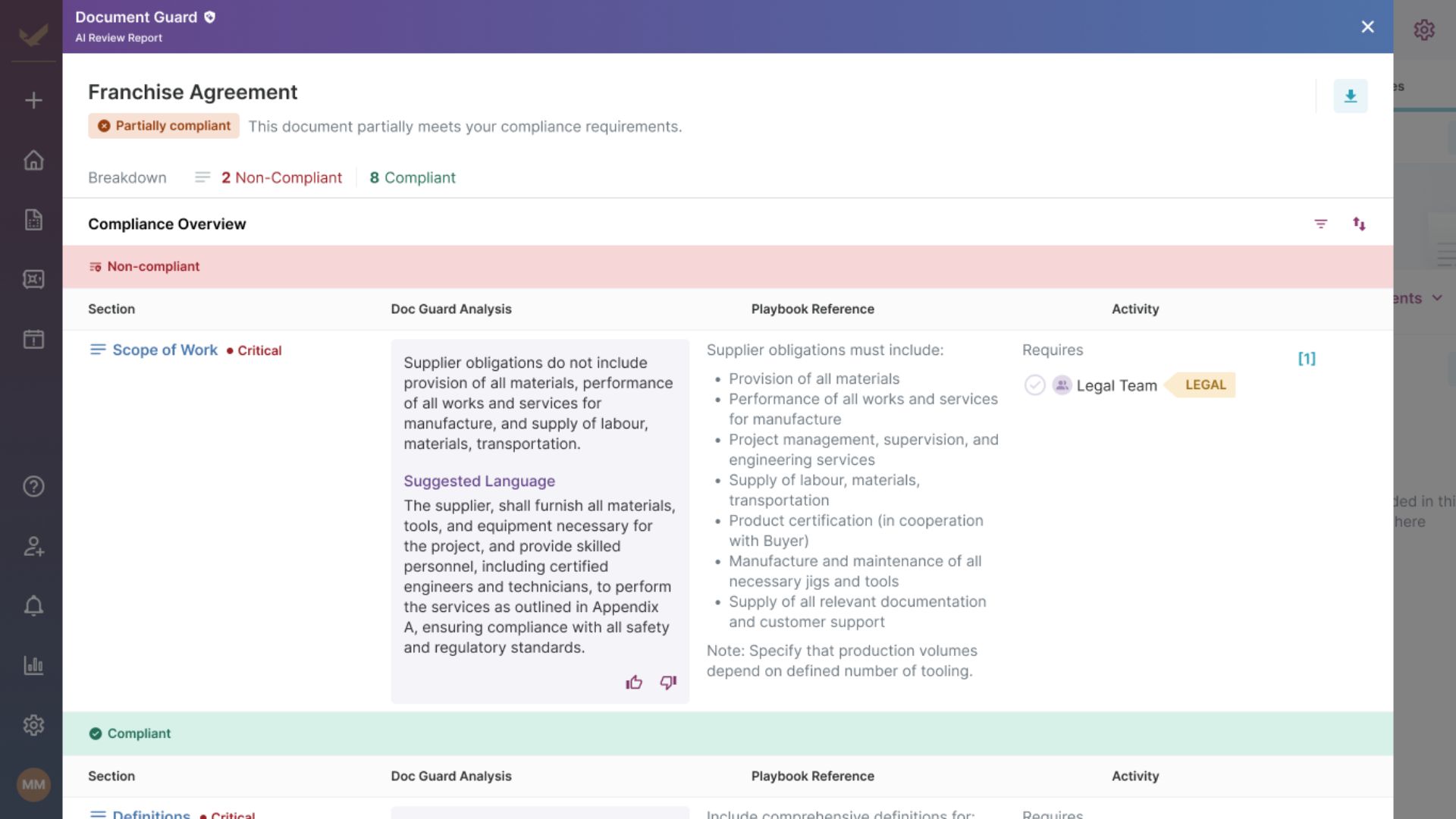
One of the key areas where AI helps is contract review. It can analyse each clause to identify potential risks and deviations from approved playbooks and explain why a provision may need to be changed. AI can also assign risk scores to highlight clauses that require attention to reviewers and suggest alternative language that aligns with internal playbooks and applicable regulatory requirements.
3. Approval Routing
AI review results can trigger automated approval workflows, routing contracts to the appropriate subject-matter expert or reviewer based on the risk level and contract terms in question in accordance with predefined rules. For instance, contracts with noncompliant financial terms can be automatically routed to Finance for review and approval.

4. Document Search
With intelligent search that understands file metadata and content, business teams can find documents more easily by searching for specific details rather than relying solely on file names or folders. OCR can also extract searchable text from scanned documents, allowing users to find relevant agreements and information without manually browsing through files.
5. Obligation Tracking
AI can read and analyse contract terms to identify key dates and obligations, and can surface these details through automated notifications and alerts. This helps business teams monitor their obligations and take action when needed.
Related Reading: What Is Contract Tracking Software?
6. Contract Performance and Reporting
Contract performance monitoring and reporting is another key area where AI can provide significant value. AI can analyse contract data to identify trends, patterns, and potential issues, and surface these insights through dashboards and reports. This gives teams greater visibility into contract performance, risks, and other key metrics.
7. Document Integrity and Version Control
Some AI systems can also help main document integrity and version control. Lexagle’s Document Guard™, for instance, links AI analysis and compliance results to the specific document version being reviewed. In this system, the updated version can be identified and flagged for reevaluation when changes are made to an agreement after review, helping ensure that changes are validated before the contract progresses.

The Benefits of AI in Contract Management
The value of AI in contract management is more than just making daily contract work easier for legal and business teams. It can also create broader organisational benefits, such as the following:
1. Reduced Contract Risk
With AI-assisted review, business teams and legal can identify risky or unusual terms early in the contract lifecycle. This allows parties to address issues proactively during drafting and negotiation rather than discovering them after signing.
2. Improved Contract Compliance
Contract management AI can help ensure compliance in not just the contract itself, but also in its performance. AI-powered contract review helps ensure that contracts align with approved playbooks before they are signed. Meanwhile, AI obligation tracking helps teams fulfill contractual obligation on time by surfacing key commitments and deadlines, as well as providing automated reminders.
3. Faster Contract Turnaround
AI's automation capabilities can reduce the time contracts spend in review, approval routing, and document retrieval, ultimately shortening the overall contract lifecycle.
Related Reading: How Contract Automation Can Reduce Contract Lifecycles By Up to 70%
4. Reduced Costs and Faster Revenue Realisation
By reducing compliance risks, disputes, and missed obligations, AI can help organisations minimise costs associated with penalties, remediation, and potential litigation. Moreover, businesses can realise revenue sooner by accelerating contract turnaround and renewals, and preventing delays during negotiation, signing, and contract performance.
5. Better Strategic Decision-Making
AI can analyse contract performance metrics to surface trends, patterns, and insights that support better business decisions. When connected with other business systems, such as ERP and CRM tools, contract data can also contribute to broader business intelligence. This gives the organisation a more complete view of business performance and helps business leaders make more informed decisions.
Choosing the Right AI Approach for Contract Management
There are several ways your organisation can adopt AI for contract management. Here are the three approaches you can adopt:
1. General-Purpose AI
General-purpose AI can be useful for ad hoc individual tasks such as summarising contracts, explaining clauses, generating provisions, or extracting metadata. However, while helpful for isolated contract tasks, tools like ChatGPT or Gemini are not designed to manage the broader contract lifecycle. Business teams may still need to perform other tasks manually or rely on separate systems for activities such as routing agreements for approval, requesting signatures, tracking obligations, monitoring key dates, storing and organising files, and managing versions.
2. Specialised Contract AI
Specialised contract AI are tools designed to assist legal and business teams with contract tasks. They can perform many of the same tasks as general-purpose AI tools, such as summarising agreements, extracting metadata, and generating provisions. However, as they are optimised specifically for legal and contractual use cases, specialised contract AI can provide more precise capabilities for contract work.
Beyond these basic functions, specialised contract AI can assist with more advanced tasks such as contract review, risk detection, clause analysis, and redlining. For example, these tools can analyse agreements against your predefined playbooks or rules, identify potentially risky provisions, and suggest compliant alternative language.
However, specialised contract AI is generally focused on improving specific parts of the contract process rather managing the entire lifecycle. Teams may still need separate solutions for other contract lifecycle management activities, such as contract storage, approvals, version control, and obligation tracking. Nonetheless, some specialised contract AI tools can integrate with existing contract management systems, allowing teams to incorporate these AI capabilities into their existing workflows.
3. AI-Powered Contract Management Solutions
AI-powered contract management solutions combine AI capabilities with features for managing the broader contract lifecycle. In addition to supporting tasks such as contract drafting, review, clause analysis, risk detection, and metadata extraction, these platforms can have AI deeply integrated into workflows for approvals, negotiations, e-signatures, storage, version control, and obligation tracking.
This integration enables teams to not only analyse individual agreements, but also automate and manage contract workflows across the contract lifecycle, from creation through performance. For example, AI can extract key terms and obligations from a contract and use this information to populate contract data and trigger reminders for important dates. It can also analyse clauses, assign risk scores based on predefined criteria, and route contracts to the appropriate reviewer based on those results.
Thus, AI-powered contract management platforms are especially useful for businesses that want to extend the benefits of AI across the entire contract lifecycle rather than use it for isolated tasks. This allows teams to bring AI capabilities and contract management workflows together in a single platform.
If your organisation is looking to adopt AI beyond individual contract tasks, an AI-powered contract management software provides a way to apply these capabilities across the lifecycle.
Experience AI Across Your Contract Lifecycle
From extracting contract data and reviewing clauses to routing approvals, tracking obligations, and maintaining document integrity, Lexagle’s Document Guard™ can support teams throughout the contract lifecycle.


