












.png)
.png)
.png)
.png)
.png)
.png)
.png)
.png)

Why Does Logistics Need Contract Management Software?
Logistics organisations manage a high volume of complex agreements across carriers, suppliers, warehouse operators, and customers. These contracts often span multiple jurisdictions and entail different regulatory requirements, making manual contract management both impractical and risky.
CLM software helps logistics teams automate repetitive tasks, improve contract visibility, and maintain timely compliance with key obligations and renewals. It also centralises contract storage and consolidates contract data into performance metrics and business insights.
Stay on Top of Every Contract Obligation
Automate renewal reminders, obligation tracking, and approval workflows to stay compliant with every contractual commitment. Receive proactive notifications for critical deadlines before they become costly risks.
.png)
Best Contract Management System for Logistics (2026)
While few CLM solutions are tailored for logistics, many providers offer the needed features to manage transportation, freight, and shipping agreements. These include: Lexagle, HyperStart, SAP Ariba, ContractSafe, Sirion, and Icertis.
The table below compares their core features and capabilities, highlighting how each solution supports the contract management needs of logistics organisations.
1. Lexagle
Lexagle is an AI-powered CLM solution that enables businesses to manage agreements at every stage of the contract lifecycle. It has supported businesses across the logistics industry, particularly in the shipping sector, in automating contract processes, improving collaboration, and managing contract obligations.
Software Highlights
- Comprehensive AI capabilities for contract drafting, redlining, approval workflows, obligation tracking, smart search, OCR, and analytics with dashboards
- Complete contract lifecycle management with native e-signatures and dedicated internal and external workspaces
- Flexible API integrations with TMS, WMS, and ERPs
- Fast implementation (1-3 months) and a user-friendly and intuitive interface that supports rapid adoption across logistics organisations
- Supports logistics compliance, especially maritime compliance, by helping businesses manage obligations aligned with IMO, SOLAS, and the ISM Code
- Demonstrated results in logistics operations, with customers in the shipping industry achieving up to a 60% reduction in contract approval turnaround time
Best For: Logistics organisations looking for rapid adoption, AI-powered end-to-end contract management, seamless integrations with logistics applications, and support for industry-specific requirements.
2. HyperStart
HyperStart is a CLM software that helps organisations automate contract processes across the entire lifecycle.
Software Highlights
- Fast implementation time (approx. 1-1.5 months), making it suitable for organisations seeking quicker deployment
- User-friendly interface with only a minimal learning curve at the start of implementation
- Covers the full contract lifecycle, including built-in e-signatures
- Provides AI-powered capabilities across key contract management processes, including drafting, searching, reviewing, tracking, reporting, and workflow automation
- Supports custom integration via API with ERPs and TMS
Limitations
- No publicly documented support for compliance with specific logistics regulatory frameworks (e.g. IMO, SOLAS, & ISM Code)
- No publicly documented support for integration with WMS
Best For: Logistics organisations prioritising contract automation and faster implementation, without requiring extensive multilingual support.
3. SAP Ariba
SAP Ariba is an enterprise platform designed to manage contracts alongside sourcing and procurement processes within the SAP ecosystem.
Software Highlights
- Part of the SAP ecosystem, making it compatible for organisations already using SAP solutions
- Supports integrations with ERP systems via APIs and enables TMS and WMS connectivity through the SAP ecosystem and APIs
- Provides built-in features for the entire contract lifecycle (except e-signatures)
- Includes smart capabilities for contract drafting, searching, reviewing, tracking, reporting, and workflow automation
Points for Consideration
- Does not include built-in e-signatures, requiring integration with a third-party provider
- Implementation typically ranges from 4 to 18 months, depending on deployment complexity and organisational requirements
- The interface may have a steeper learning curve (based on reviews), particularly for new users or organisations without prior SAP experience
- No publicly documented support for compliance with specific logistics regulatory frameworks (e.g. IMO, SOLAS, & ISM Code)
Best For: Logistics organisations that rely on SAP applications want a CLM software that readily integrates with their existing technology stack.
4. ContractSafe
ContractSafe is a CLM platform designed for quick deployment, offering core contract management capabilities across the contract lifecycle.
Software Highlights
- Designed for rapid deployment, with implementation typically completed in hours to days
- Provides built-in capabilities for the entire lifecycle
- Includes AI automation for drafting, search, negotiations, approvals, obligation tracking, reminders, and reporting
Points for Consideration
- No publicly documented integrations with TMS or WMS
- No publicly documented support for specific logistics regulatory frameworks (e.g., IMO, SOLAS, & ISM Code)
- No dedicated workspace for internal and external stakeholders
- Offers fewer customisation options than some enterprise-focused CLM platforms
Best For: Logistics organisations that value rapid implementation and core CLM capabilities over advanced customisation, complex workflows, extensive integrations, or dedicated collaboration environments.
5. Sirion
Sirion is a CLM platform with AI capabilities that supports organisations throughout the contract lifecycle, including those in the freight and carrier industry.
Software Highlights
- Includes specific capabilities for freight and carrier contract management
- Comprehensive contract lifecycle management (except built-in e-signatures)
- Has AI capabilities for drafting, search, negotiations, approvals, obligation tracking, reminders, and reporting
Points for Consideration
- Longer implementation timeline (approximately 6-12 months)
- No publicly documented support for compliance with IMO and ISM Code
- Does not include built-in e-signatures, requiring third-party integrations
- Interface may involve a steeper learning curve (based on reviews)
Best For: Logistics organisations, particularly freight and carrier businesses, prioritising advanced AI capabilities and end-to-end contract lifecycle management, with the capacity to support a longer implementation and familiarisation period for users.
6. Icertis
Icertis is a CLM software with configurable workflows and integrations across enterprise systems, enabling organisations to manage contracts across the lifecycle.
Software Highlights
- Covers the full contract lifecycle (except built-in e-signatures)
- AI capabilities across drafting, search, negotiations, approvals, obligation tracking, reminders, and reporting
- Supports ERP integrations via APIs, and TMS and WMS connectivity through SAP
Points for Consideration
- Longer implementation timeline (approx. 6-12 months) compared to other solutions
- Built-in e-signatures are not included
- Users may require more time to become familiar with its features (based on reviews)
- No publicly documented support for compliance with specific logistics regulatory frameworks (e.g., IMO, SOLAS, and the ISM Code)
Best For: Logistics organisations already using multiple business systems for contract management that require broad integrations and configurable workflows, and are prepared for a longer implementation process
To help you compare these platforms in greater detail, the table below breaks down their core contract management capabilities across the features that matter most to logistics organisations.
What to Look for in Logistics Contract Management Software
1. AI-Powered Contract Review and Comparison
Logistics and transportation companies often manage hundreds to even thousands of supplier, carrier, freight, and warehouse agreements, with terms varying across carriers, routes, and regions. AI-assisted contract review helps business teams review contracts more efficiently while reducing the risk of overlooking critical terms.
When evaluating a CLM solution, look for AI capabilities that can:
- Automatically extract key contract data, including renewal dates, pricing terms, notice periods, governing laws, obligations, and service levels.
- Identify potentially risky clauses, such as unfavorable liabilities, indemnities, or payment provisions that likely need legal purview.
- Highlight deviations from approved templates so teams can review nonstandard language before contracts are finalized.
- Compare contract versions to quickly identify modifications between versions and redlines.
- Compare contractual pricing against agreed freight rates or commercial terms (where supported).
2. Centralised File Storage with Smart Search
Apart from handling agreements, logistics and transportation businesses also need to keep a record of the supporting documents associated with each contract (e.g., amendments, pricing schedules, insurance certificates, & other exhibits).
As contract portfolios grow, the simple act of manually locating the right file becomes a task in itself that consumes valuable work hours.
Thus, your contract management software should include the following features that make storing, organizing, and retrieving contracts faster:
- Metadata extraction to locate specific agreements using key details such as contract dates, counterparties, clauses, or renewal periods without manually opening each file.
- File relationships to keep contracts linked with their related attachments and exhibits in one centralized location.
- OCR to read scanned documents, making them searchable and supporting digital transformation initiatives.
- Advanced filtering to quickly find contracts by criteria, like contract type, supplier, carrier, or status.
3. Contract Tracking and Automated Reminders
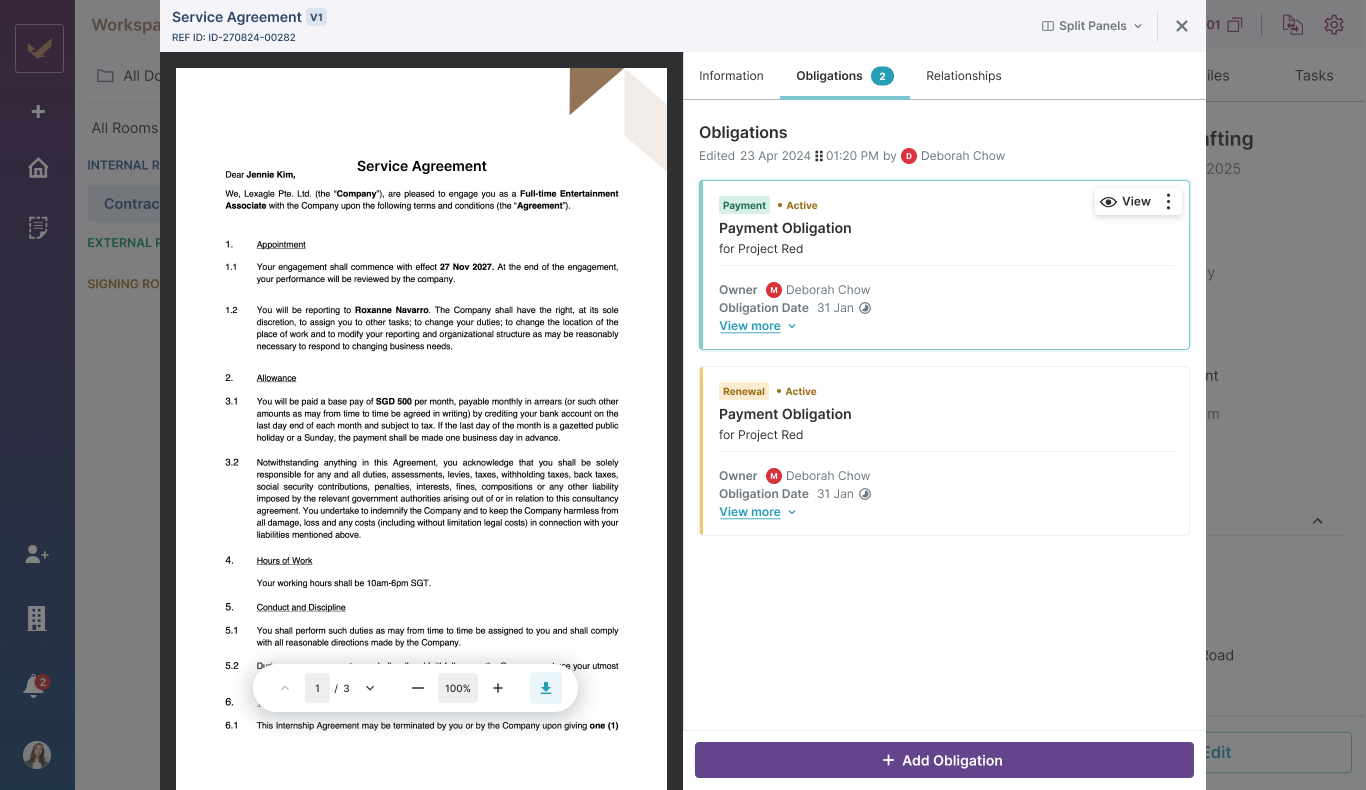
For logistics and transportation teams, complying with obligations is critical to avoid penalties, service disruptions, and disputes. A CLM software helps keep teams compliant by:
- Tracking where each contract is in its lifecycle, and
- Automatically notifying your team of key contract milestones, deadlines, renewal dates, payment schedules, notice periods, and other critical obligations.
These ensure that important obligations are not overlooked.
4. Workflow Automation, Collaboration, and Integrations
Managing large volumes of contracts also entails managing a large volume of approvals, review, signature requests, and both internal and external coordination. Handling these workflows manually can lead to delays, fragmented communication across email and shared drives, and confusion over the latest contract version.
When assessing a CLM platform, look for these features:
- Approval workflows that automatically route agreements to the right reviewers based on risk, value, or contract type.
- Audit trails that maintain version history and provide visibility into every change and approval.
- Built-in collaboration tools for commenting, reviewing, and communicating with internal teammates and counterparties in one place.
- Integrations with other logistics platforms, like ERP, TMS, WMS, and e-signature platforms.
5. Contract Analytics and Performance Monitoring
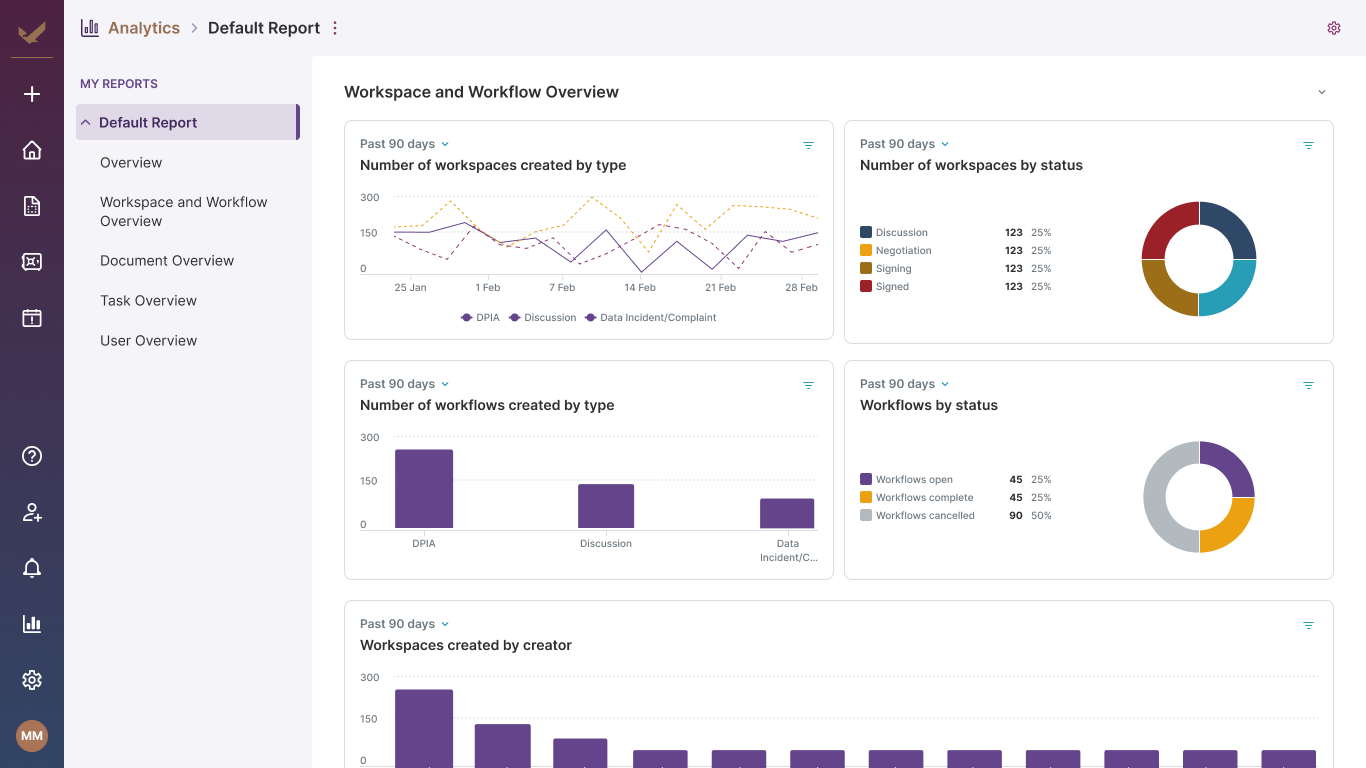
A unique benefit brought by AI-powered CLM software is its ability to provide actionable contract analytics.
Instead of manually consolidating data into spreadsheets, built-in dashboards give teams an overview of important metrics, such as the number of contracts by the following to name a few:
- Value
- Status
- Type (e.g., freight, transportation, charter, & warehouse)
- Counterparty (e.g., supplier & carrier)
- Average turnaround time
- Obligation completion rate
- Renewals
These insights help logistics and transportation businesses identify trends, monitor contract performance, and make more informed business decisions.
If you're looking for a CLM solution that meets the capabilities covered in this guide, Schedule a Demo to see how Lexagle helps logistics organisations manage complex contracts more efficiently.


