









.png)
.png)
.png)
.png)
.png)
.png)
.png)
.png)

A Review: What is a Contract Amendment?
A contract amendment is a legal record used to make substantive changes to an agreement, such as modifying or removing existing clauses that affect the parties’ rights, obligations, or responsibilities. It is distinct from a contract addendum, which only supplements an agreement without altering its original text.
Amendments are typically used to adjust pricing, update compliance requirements, revise milestones, or modify termination clauses. Because these changes directly impact the original contractual terms, they often require a more rigorous review process to ensure all parties remain protected.
Not sure if you need an amendment or an addendum? While an amendment changes existing terms, an addendum adds new ones. To ensure you’re using the right document for your specific situation, check out our full comparison guide: Contract Amendment vs. Addendum: Which One Do You Need?
Steps in Writing a Contract Amendment
A well-drafted amendment ensures that any change is clearly defined and legally enforceable. Here are the steps you can follow when writing one:
Step #1: Maintain Consistent Document Formatting
Prepare the amendment using the same document size, layout, and general formatting for uniformity and to preserve a professional appearance.
Step #2: Identify the Original Agreement
Clearly state the title and execution date of the original contract to establish a direct connection between the amendment and the agreement it revises.
Step #3: Restate the Contracting Parties
List the names and designations of all parties, even if they appear in the original document, to avoid ambiguity.
Step #4: Indicate Relevant Dates
Provide the date the amendment is signed, as well as the date when the changes will become effective (if different).
Step #5: Outline the Revisions
Precisely indicate which provisions are being altered. Use strikethroughs and underlines to highlight changes. Limit the scope strictly to the provisions being modified.
Step #6: Explain the Modifications Clearly
Accompany the revisions with a clear explanation of what has been changed. For example: “This amendment deletes Section [X] in its entirety and substitutes it with the following: ‘[new provision].’”
Step #7: Clarify the Validity of the Contract
Include a provision confirming that all unaffected terms remain enforceable. For example: “All provisions not expressly revised by this amendment shall continue in full force and effect.”
Step #8: Include a Non-Variation Clause
State that any further changes must be made through a written document signed by all parties.
Step #9: Provide Signature and Notary Blocks
Add signature lines for each party, including their printed names and designations. Include a notarization if required under applicable laws or the original agreements.
Step #10: Check Compliance with Applicable Laws
Ensure that the amendment aligns with the governing law of the contract. It is advisable to have the document reviewed by a qualified professional to confirm its validity and enforceability.
Contract Amendment Sample Template
To visualize these steps in practice, the sample below outlines a standard structure for modifying existing terms. Use this template as a foundational draft, ensuring you tailor the specific language to your agreement and seek legal counsel to confirm its validity.
AMENDMENT TO [ORIGINAL CONTRACT TITLE]
Amendment to: [Original Contract Title]
Date of Original Contract: [MM/DD/YYYY]
This Amendment is made and entered into on [Amendment Date], by and between:
[Party A Name], a [type of entity/individual] organized and existing under the laws of [jurisdiction], with address at [address], and
[Party B Name], a [type of entity/individual] organized and existing under the laws of [jurisdiction], with address at [address],
(collectively referred to as the “Parties”).
1. Purpose
The Parties desire to amend certain provisions of the Agreement as set forth in this Amendment. Except as expressly amended herein, all other terms and conditions of the Agreement shall remain in full force and effect.
2. Amendments
The Parties agree to the following modifications:
- Amendment to Section [X]: Section [X] of the Agreement is hereby deleted and replaced with the following: [Insert revised provision here]
- Amendment to Section [Y]: Section [Y] of the Agreement is hereby deleted in its entirety and shall be of no further force or effect.
Only the provisions specified above are amended. All other provisions remain unchanged.
3. Effectivity
This Amendment shall take effect on [Effective Date].
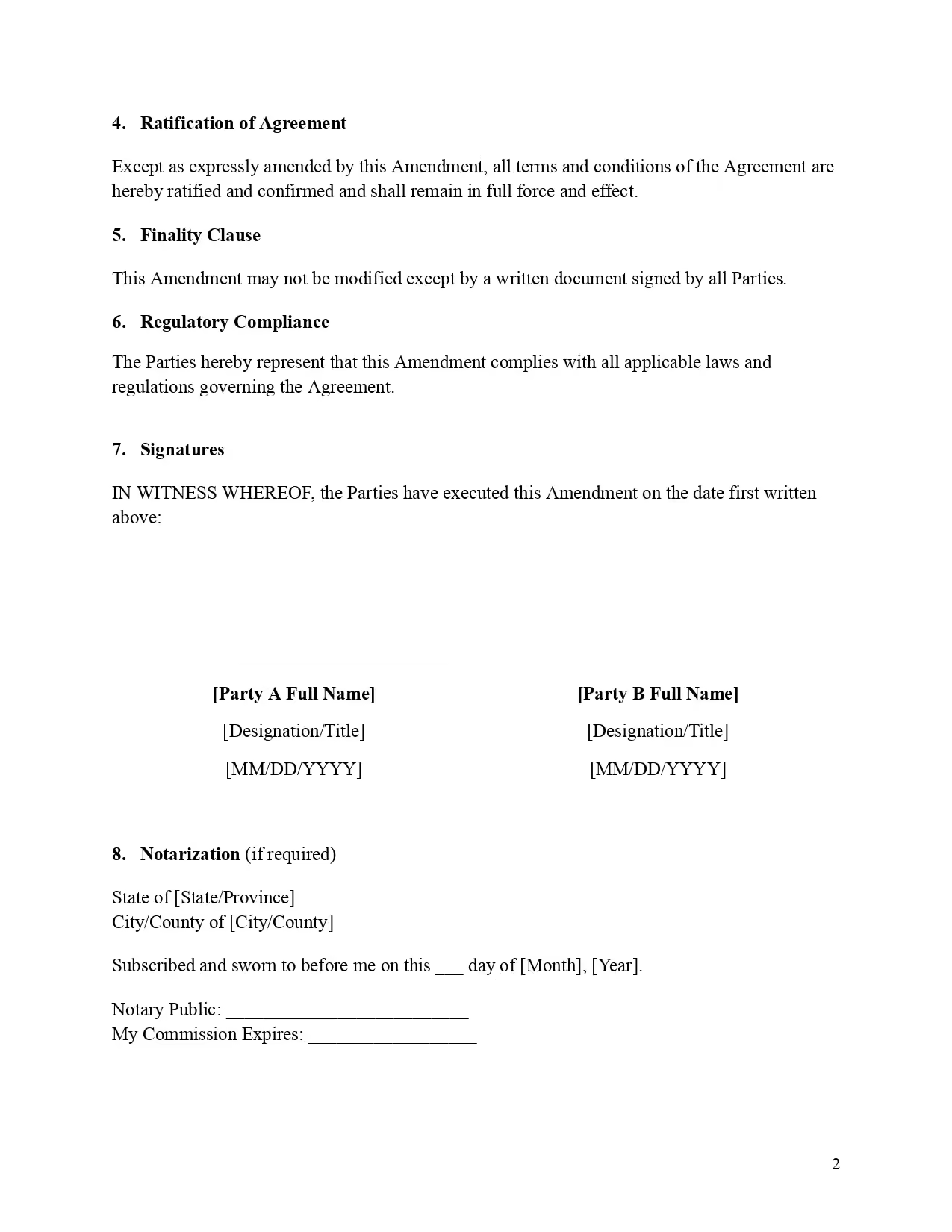
4. Ratification of Agreement
Except as expressly amended by this Amendment, all terms and conditions of the Agreement are hereby ratified and confirmed and shall remain in full force and effect.
5. Finality Clause
This Amendment may not be modified except by a written document signed by all Parties.
6. Regulatory Compliance
The Parties hereby represent that this Amendment complies with all applicable laws and regulations governing the Agreement.
7. Signatures
IN WITNESS WHEREOF, the Parties have executed this Amendment on the date first written above:
_________________________________ _________________________________
[Party A Full Name] [Party B Full Name]
[Designation/Title] [Designation/Title]
[MM/DD/YYYY] [MM/DD/YYYY]
8. Notarization (if required)
State of [State/Province]
City/County of [City/County]
Subscribed and sworn to before me on this ___ day of [Month], [Year].
Notary Public: __________________________
My Commission Expires: __________________
Document Overview of Contract Amendment Template
The document preview below illustrates how the above formal contract amendment should be structured, spaced, and arranged on a standard page.
![A visual preview of a contract amendment template, page 1. The document is professionally formatted on a clean page with the bold main heading "AMENDMENT TO [ORIGINAL CONTRACT TITLE]". It includes standard legal boilerplate with placeholders for the title, date, and full party names and addresses. Numbered sections cover "1. Purpose" (detailing the modification intent), "2. Amendments" (with structured bullet points to describe deleted and replaced clauses), and "3. Effectivity" (for the effective date). This template perfectly illustrates the layout for the plain-text clauses provided..](https://cdn.prod.website-files.com/61dbb38f6612f97003df0f0d/6a0c244a479ba8e329d1e4b3_contract-amendment-sample-template-lexagle-page-1.avif)
The Next Steps: What to Do After Drafting Your Amendment
After finalizing your amendments and having them signed, the final step is to ensure that they are properly archived alongside the original contract for future reference. For scaling businesses, manually managing high volumes of these updates can be a significant challenge.
To address this, many teams are turning to centralized document management systems like Lexagle. Instead of relying on static folders, platforms like Lexagle provide a cloud-based repository that ensures easy access from anywhere.
The Lexagle Difference: A leading Philippine manufacturing firm used Lexagle to centralize their contract repository, enabling them to track and retrieve the most current versions of every agreement instantly. By moving away from manual tracking, they achieved a 25% reduction in contract disputes, ensuring all parties always had immediate access to the correct, updated terms.
Manual tracking is a risk your business doesn’t have to take. Talk to our specialists today to learn how Lexagle provides a single source of truth for your team's amendments and original agreements.
Contract Amendment Checklist: Elements to Include
Before sending your contract amendment for signatures, you must verify that all its critical components are included. Addressing these elements prevents future ambiguity and preserves the legal integrity of the updated agreement, ensuring the new modifications and the original terms are cohesive and consistent.
Here are the essential elements you should include:
- Title of the Amendment. Clearly indicate that the document is an amendment to an existing contract.
- Reference to the Original Contract. Identify the agreement being amended, including its title and execution date.
- Identification of the Parties. Clearly state the names and designations of all parties involved in the amendment.
- Execution and Effectivity Dates. Specify the date the amendment is signed and the date it takes effect, if different.
- Description of Amendments. Provide a clear and precise explanation of the changes, including any additions, replacements, or deletions of provisions.
- Ratification Clause. Confirm that all provisions not amended remain valid and enforceable.
- Statement of Finality. State that any further amendments must be made in writing and signed by all parties.
- Compliance with Governing Law. Include a statement ensuring that the amendment complies with the applicable laws and regulations governing the contract.
- Signature Blocks. Provide spaces for the signatures, printed names, and designations of all parties.
- Notary Block (if applicable). Include a section for notarization to authenticate the document, if required by law or the original agreement.
Disclaimer: This article is intended for informational purposes only and should not be considered legal advice. Lexagle does not provide legal services. Readers should consult a qualified legal professional for advice regarding their specific legal matters.