









.png)
.png)
.png)
.png)
.png)
.png)
.png)
.png)

What Is a Unilateral Contract?
A unilateral contract is an agreement where one party makes a promise or offer that another party can accept solely by performing an action or completing a certain task. Under this agreement, only one party (the offeror) makes a legally binding promise. The offeree is under no obligation to perform the requested action; however, they are only entitled to receive what the offeror promised if and when they completely fulfill the terms of the offer.
In business, unilateral contracts are often used for performance-based incentives, such as open referral programs. This is because unilateral contracts do not secure a mutual exchange of promises. They merely incentivize a specific outcome without legally binding the counterparty to deliver it.
For instance, when a company launches an open referral program, they issue a unilateral offer promising a fixed payout to anyone who brings in a qualifying new client. Through this, the company secures a risk-free marketing channel, as they are only obligated to pay if someone successfully completes a referral. At the same time, program participants face zero penalties or legal liabilities if they never refer a single client, giving them complete freedom to act on or ignore the offer entirely.
What Is a Bilateral Contract?
A bilateral contract is an agreement where both parties make promises to each other to do or not to do something in the future. Under this contract type, both parties make promises to each other and are legally obligated to fulfill them. A party faces legal repercussions if they fail to deliver on their promises.
As such, this contract type is standard for nearly all contracts in business, whether it's for internal stakeholders like employment contracts, or external ones like sales contracts, vendor agreements, service contracts, and lease agreements, to name a few. This is because bilateral contracts secure a valuable exchange while providing legal protections.
For instance, when a company signs a service agreement with a contract lifecycle management (CLM) provider, the business secures a valuable tool to streamline its contract workflows, while the provider is guaranteed payment. At the same time, the company is protected if service obligations are not met, gaining specific cure periods to demand a fix or terminate without penalty, while the provider has ways to seek recourse if payments are withheld.
Due to their importance, bilateral contracts require considerable time and effort to draft, review, negotiate, approve, and sign. This process often involves extensive internal back-and-forth across teams within the organization, especially with legal, and external counterparties. To prevent bottlenecks, businesses use CLM platforms to automate the review, negotiation, approval, and signing processes.
Unilateral vs. Bilateral Contract: Key Differences
The primary difference between a unilateral and bilateral contract is in the number of parties fulfilling an obligation. In a unilateral contract, only one party: the offeror, is legally bound to fulfill their obligation. On the other hand, in a bilateral contract, both parties have to perform the responsibilities they agreed to do for each other.
Nonetheless, this spills into the other aspects of the contractual relation and workflow, such as negotiation time, approval process, signature requirement, and enforceability.
As shown in the table, in a unilateral contract, only the offeror creates the terms on a take-it-or-leave-it basis: “Once you do X, I’ll give you Y.” As such, there is typically no negotiation or approval involved with a counterparty. Signatures are also unnecessary, as the offeree’s completion of the requested action serves as the acceptance. Only once this performance occurs is the offeror legally obligated to fulfill their promise.
On the other hand, in a bilateral contract, the agreement is enforceable even before the parties start fulfilling their responsibilities, as they have accepted each other’s commitments by signing the document. It works on an “If you promise to do or not to do X, I promise to do or not to do Y” basis.
Given that parties will be legally bound to each other even prior to commitments being fulfilled, a lot of internal review and negotiation happen, along with external communication with counterparties. In business, negotiation and approval are generally more complex since the agreement moves through different departments and internal hierarchies.
That is even before sending the contract to the counterparty for their approval. Due to this complexity, businesses usually use a CLM to seamlessly route the contract through every internal stakeholder and, consequently, their counterparties.
When To Use Unilateral and Bilateral Contracts
Contrary to popular belief, bilateral contracts are not inherently better than unilateral contracts in the business context. Each contract type has its own advantages and limitations.
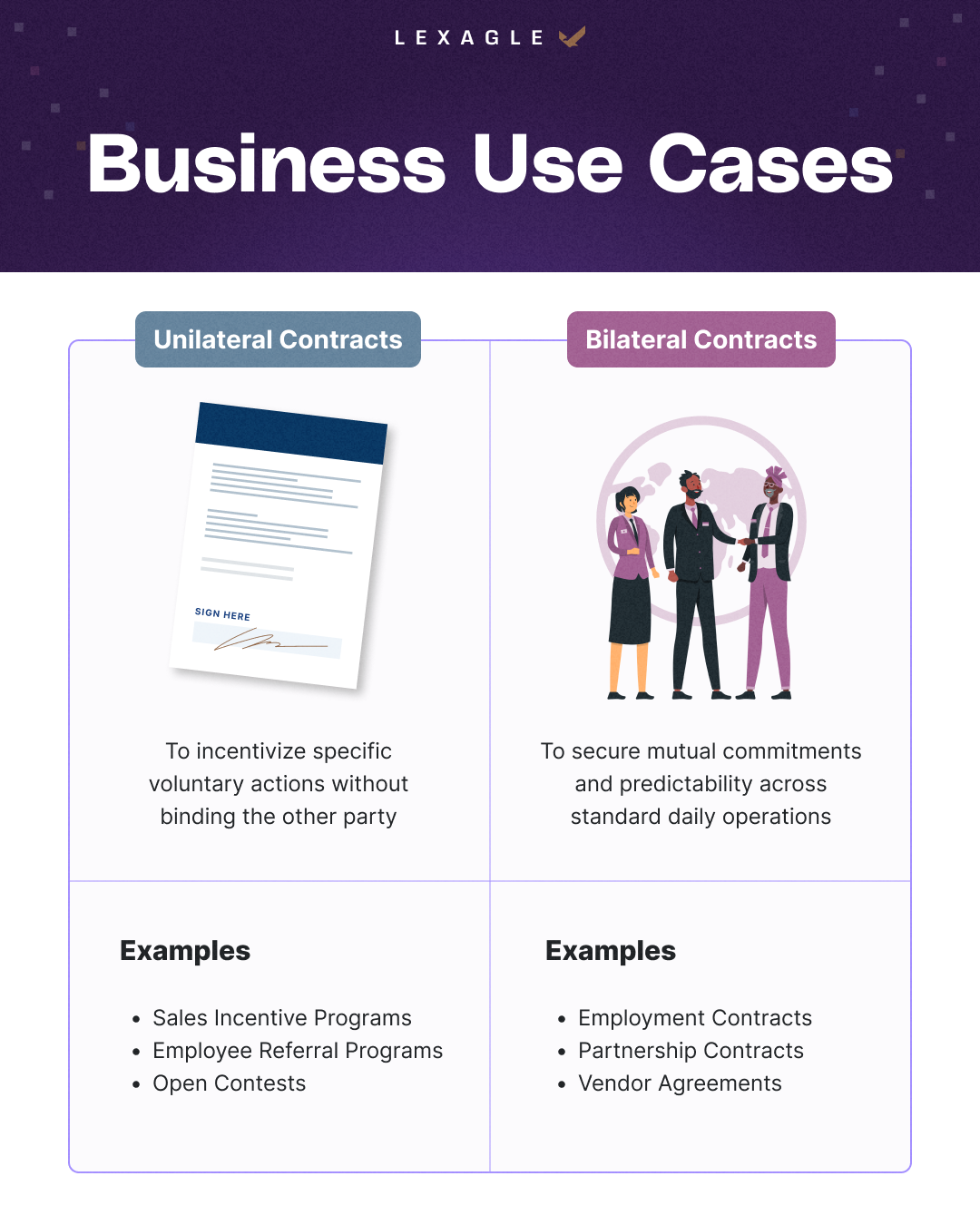
Use Cases for Unilateral Contracts
Unilateral contracts are most useful when one party wants to encourage a specific action or behavior without immediately binding the other party to a promise. This provides flexibility for the party making the offer.
In business, unilateral contracts are seen in:
- Sales incentive programs: A company will give a certain amount to the salesperson who reaches or exceeds a specific quota in a given timeframe. If they don’t reach the quota, they won’t receive the cash bonus.
- Employee referral programs: If a current employee successfully refers a candidate who is hired for an open position, their employer will give them a specific cash incentive.
- Open contests: A company promises a reward or prize to any participant who submits the winning entry or successfully completes the contest requirements, with no obligation for anyone to participate unless they choose to.
While flexible, unilateral contracts carry the inherent risk that the other party may never perform the required act. Going back to the employee referral program example, since current employees are under no obligation to refer candidates, they may simply choose not to participate. This can leave crucial roles vacant for longer and ultimately make hiring more difficult for the organization.
Use Cases for Bilateral Contracts
On the other hand, bilateral contracts are best suited when both parties want to make mutual commitments, which creates predictability, builds trust between parties, and reduces misunderstandings.
Because businesses thrive on this predictability, bilateral agreements serve as the foundational framework for almost all commercial agreements you can think of. These include, among others:
- Employment Contracts: Where an employer promises compensation and benefits in exchange for the employee's labor and adherence to company policies.
- Partnership Contracts: Where entities agree to pool resources and share profits, losses, and operational responsibilities.
- Vendor & Procurement Agreements: Where a business secures a steady supply of goods or materials in exchange for guaranteed, timely payments.
- Non-Disclosure Agreements (NDAs): Where both parties mutually promise to protect confidential business data, with clear legal recourse if a leak occurs.
However, as bilateral contracts remain embedded in the daily operations of all core business functions, the stakes for getting them right are incredibly high. Ultimately, poorly drafted terms leave room for ambiguity, which can quickly lead to costly disputes and operational risks.
How Businesses Effectively Manage Bilateral Contracts in 2026
Managing a unilateral contract is relatively straightforward. They rarely, if ever, require the back-and-forth negotiations and external counterparty approvals that drain a large percentage of your team’s daily hours. The workflow is typically linear: once you publish the terms, you simply wait for the requested performance to occur.
On the other hand, bilateral contracts require significant operational effort. They form the structural backbone of nearly all daily business operations, from employment contracts to vendor agreements and procurement deals. Today, scaling businesses mitigate these risks by doing these for their bilateral contract lifecycle:
1. Accelerating the Contract Drafting, Negotiation, and Approval Process
In business, the most time-consuming phase of the bilateral contract lifecycle is the presigning stage: drafting, negotiation, and approval. This is because the draft must first undergo internal reviews across multiple stakeholders before being forwarded to external counterparties, often repeating this process for every round of revision. As such, it should come as no surprise that the presigning stage is also where workflows typically stall, especially when managed manually.
To streamline these presigning processes, businesses rely on a CLM solution capable of generating contract drafts in just a few minutes. A modern CLM platform replaces chaotic manual handoffs and fragmented email threads where version control is easily lost.
Instead, it allows teams to dynamically assign tasks, manage revisions, and route the latest version of a document directly to the required stakeholders and counterparties for review and approval.
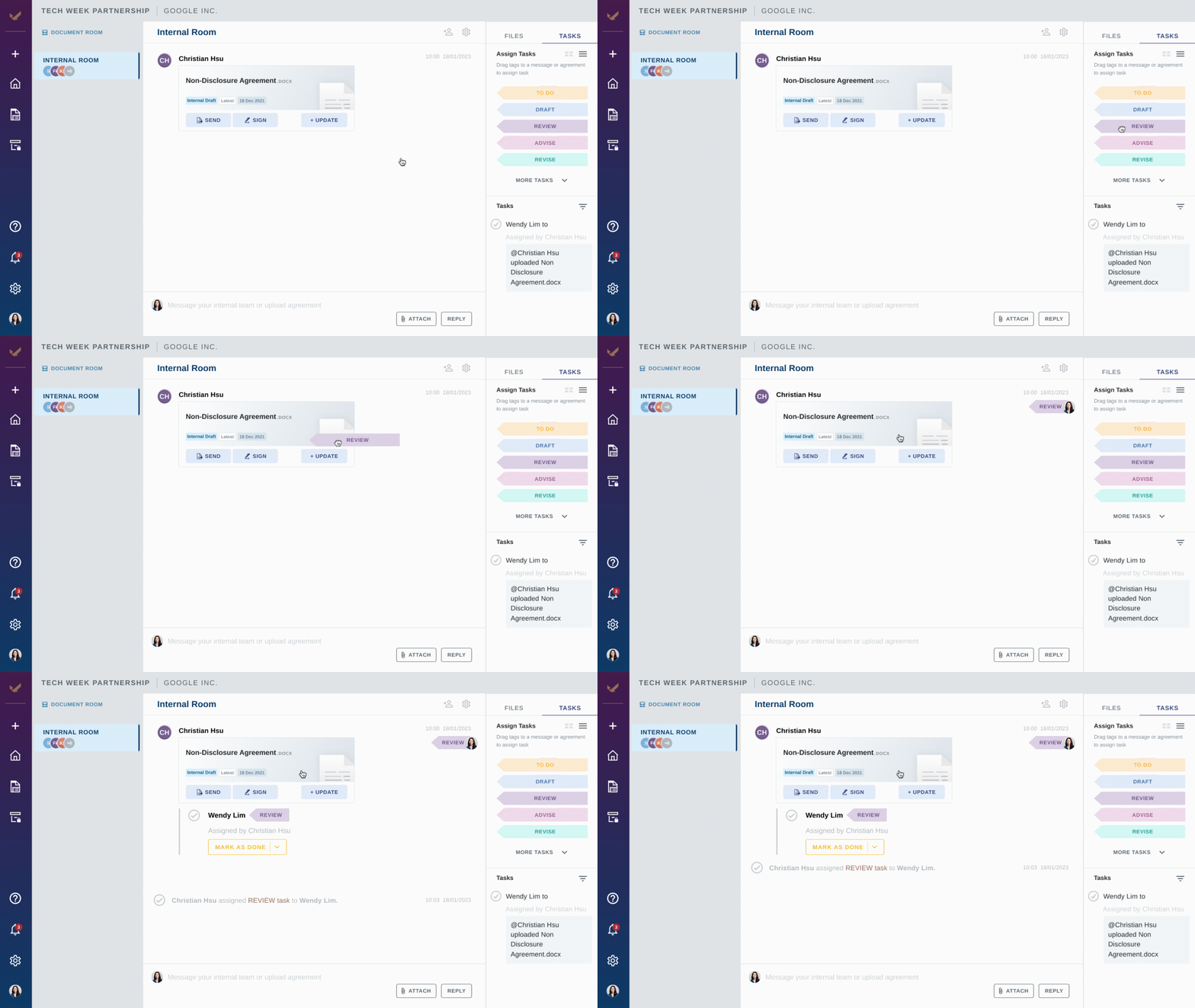
Because everything is centralized within a single platform, it is significantly easier to update files and track version history in real time, ensuring everyone stays aligned on what was actually agreed upon during contract negotiation.
2. Eliminating Delays with Secure, Built-In Digital Signatures
Signatures of the parties are a must for a bilateral contract to be legally enforceable. Traditionally, businesses typically request wet signatures by booking conference rooms for formal signing sessions, coordinating schedules, or shipping physical documents via couriers — all of which slow down deal velocity. Some also do it electronically via back-and-forth email correspondence, which may be a bit faster, but can quickly become chaotic and leaves the business exposed to tampering risks.
To prevent this, scaling businesses shift to digital signing platforms that enable parties to sign anytime, anywhere, while ensuring that documents are completely secure from tampering. This process becomes even more seamless when digital signing solutions allow for deep integration with a CLM, or are built directly into the CLM itself.
The moment the review process ends, stakeholders and external counterparties can sign the document securely right inside the platform, collapsing what used to be a weeks-long logistics headache into just a few clicks. This can lead to a three-times faster document turnaround.
3. Driving Compliance with Automatic Reminders and Reports
Once a contract is signed, its value relies entirely on the compliance of the parties to their obligations. Unfortunately, many organizations scatter signed agreements across different physical and electronic storage folders.
This lack of centralization makes it incredibly difficult to monitor compliance, which makes the business vulnerable as non-compliance can easily lead to disputes that result in a damaged business reputation, lost revenue, and costly litigation.
To stay on top of their signed agreements, future-ready businesses search for CLM solutions equipped with automatic reminders for key contract milestones, such as upcoming expiration dates or specific deadlines by which an obligation must be fulfilled. They also look for CLM platforms that can generate comprehensive contract reports, providing clear visibility into metrics like the number of obligations fulfilled versus missed, total contract value, and the overall volume of active agreements.